Mana's Beautiful World is Forever

Mana's Beautiful World is Forever

Wednesday, July 11, 2018

Back to Hiroshima Brand Shop TAU in Ginza

My long day out in Tokyo continued with a visit to Ginza. The reason I was going to so many places was because I was in between hotels. Some days can be much more expensive at some of the hotels in Tokyo, so I decided to split my time there. I cut my hotel bill in half for those days at the second hotel.

My first stop in Ginza was a favorite of mine. TAU Hiroshima brand shop. I first found out about it while watching the live action version of Wakakozake where they filmed an episode here.

I bought a few things here. For now I will share the treats I enjoyed while in Japan. 

This Onomichi lemon heart tart was really cute. They also had an orange one which I wish I had bought too. 

I got this one of the other times I shopped at TAU previously. This Toraya Hiroshima sweets lemon cake is nice. So I made sure to get it again this time.

 I also tried this Navel Orange Cake. I believe it was from Patisserie Okumoto.

I had trouble figuring out the maker of this. TAU lists it as a Sedota Orange Peel Cake. It was also nice and you can see the orange peel in the cake. 

I got a couple other things and I will share those later on. But this was something I had been looking for and finally they had Fugetsudo Hiroshima Carp Gaufres. I was happy to have found them. Fugetsudo really makes delicious gaufres cookies.

The reason I decided to make this post now instead of getting all of my photos together for it is because of the heavy rain and flooding that West Japan has experienced recently. Hiroshima is one of the areas devastated by flooding and mud slides. I wanted to share a post by Time Out Tokyo that lists a number of organizations that are working to help people impacted by this disaster. Here is the link to Time Out Tokyo. Thank you.

Tuesday, July 10, 2018

Tsukuda Shrines

When I was searching for information about the Midori statue, I found some old maps of Tsukuda Island. The first is an Edo era map of 1771 of  Tsukudajima and Ishikawajima. This would have been before the ninsoku yoseba, criminal and poverty stricken rehabilitation facility, was established. Part of the islands belonged to the Ishikawa samurai family, which is why there are two names for the area. The other part was Tsukuda, which is where the shogun's fishermen lived and kept their boats.

As you can see from the maps, the land mass of the islands grew. This is an army survey map from 1892. Before and during the Meiji Restoration period the ship building industry increased here also. By this time the area was known only as Tsukudajima.

The last map is a detailed Meiji era map. The amount of reclaimed land is even more and the water way became narrower. Eventually the ship building moved elsewhere in 1979 and the area became mostly residential with shops and businesses. And became known to most as Tsukuda. Although it still retains many of the same roads and some of the older buildings.

While there are only a few boats around Tsukuda now, there are still reflections from when the island was known for fishermen and ships. One place is Tsukuda Namiyoke Shrine.

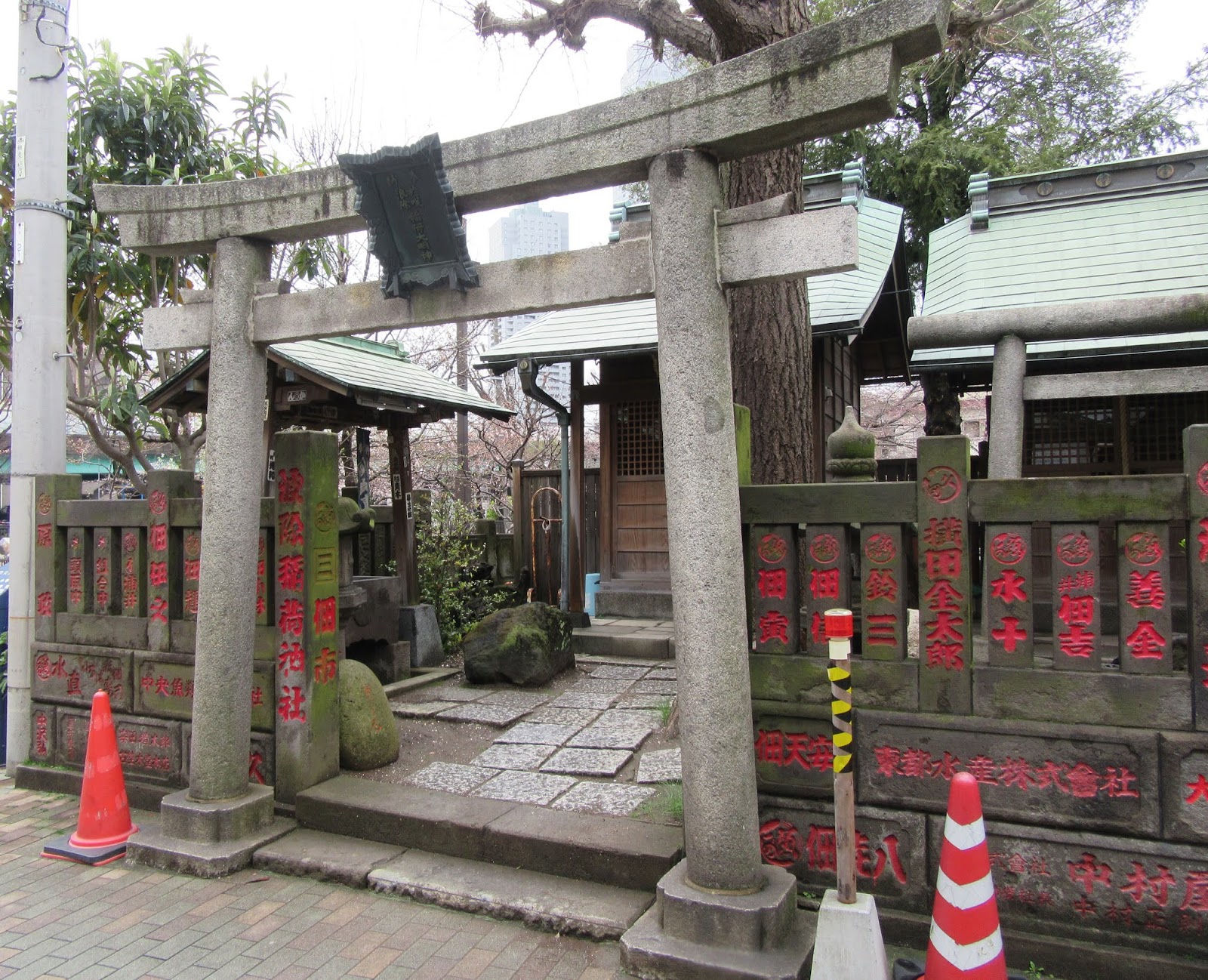
Tsukuda Namiyoke Inari Shrine was built as a place to pray for the safety of the fishermen. It is located near the Tsukuda Kobashi bridge, where the fishermen lived and kept their boats.

Even though it is small, it is well cared for. One feature of the shrine are the power lifting stones, like the one at the gate. These were used in contests of strength and are found at some shrines. The one here has "oshiri" written on it, which means smooth like one's bottom.

Another shrine in Tsukuda is Sumiyoshi Jinja. This was founded by the Osaka fishermen in 1646 for protection for their ships. The large torii features a ceramic name plate.

I don't know the age of the buildings here. Most shrines in Tokyo were rebuilt after the war. Many also are rebuilt at certain times since they are made of wood.

One of the guardian komainu at the shrine.

This is the Haiden, where prayers are offered to the enshrined gods. To the left is a brick building where the portable shrine, the mikoshi, was stored.

One of the smaller shrines. Sumiyoshi Jinja is one of the few places that has the names of the individual shrines on Google maps. This is the Funatama Shinto shrine. Interesting details on the shrine doors and carvings around the shrine.

This is the Eki Jinja Hoso shrine.

One of the amazing looking trees in the area. I do not know how old this tree is but the trunk is massive. Unless it was large when originally planted here, it probably has been here for a long time.

This post is similar to the one at the shrine in Hamamatsucho.

There is also an Inari shrine here.

Irifune Inari Shrine

The portable shrine, the mikoshi, is now stored in a newer building. Unfortunately since there were no lights on inside, this is the best photograph I could get.

A look at the grounds out towards the entrance torii.

And a bit of sky clearing near the end of my visit to Tsukuda. But not the end of my day walking around places in Tokyo. More from this day in my next post.

Monday, July 9, 2018

A Visit to Tsukuda

When I started putting this post together, it would be about my wandering through Tsukuda and a bit about the manga and anime March Comes in Like a Lion, 3月のライオン. 

Because along with the characters, many of the scenes captivated me. So I decided to take a look during my last visit to Tokyo.

And I did see places that were shown in the anime. But I also discovered there is a bit of history here too.

Spanning a tributary of the Sumida River, it is hard to miss the Tsukuda Kobashi (Tsukuda Little Bridge). It is a popular location, made even prettier with the sakura trees beginning to bloom.

Also there is this little playground, which I think was in the anime.

You would think the Tsukuda Kobashi would be historical given it's appearance. There has been a bridge in this area going back to Edo times, but it's current vermilion look was completed in 1984.

What I missed seeing is that there are buildings in this area that date back to Edo. While this isn't one, I thought it's appearance was a little unusual. Turns out it's a Chinese restaurant, Ri:Jan.

Tsukuda isn't a big area. It was a sandbar which over time was filled in with boulders and landfill. Still people are able to grow various plants including this fruit bearing tree. Not sure if they are oranges or mikan, but it was really nice to see.

I did have a destination in mind, but there were interesting things to see along the way. Like the Tsukuda Machikado Museum which houses their 3.75 ton portable shrine Sengan Mikoshi and twin lion masks called Ryuko and Kurokama, which date from the Bunsei era in the early 1800's. They are taken out every three years for their Hon Matsuri. In fact this year it will happen on August 3rd. And just to note, I must have been in vampire mode when I took this photo. No reflection in the mirror or windows. 

Another favorite place for people at Tsukuda island is the Ishikawajima park that wraps around along the Sumida River. It is featured a lot in the anime. Even on a grey cloudy day I found it a relaxing place to visit.

Just a look at one of the many bridges in the area, the Tsukuda Ohashi. Along with one of the water taxis that ferry people along the Sumida River.

Along the way is a directional paver that points to a few bridges and the river. The image reflects back to when Tsukuda was a place of fishermen and boat builders. Ieyasu Tokugawa recruited fishermen from Osaka to come to the sandbar in hopes of building a fishing village there. The name Tsukuda comes from the area where they came from,  Tsukudamura. By 1644 fishing was thriving in Tsukuda.

There are a number of stairs and ramps along the river. This one leads up to the replica Ishikawajima lighthouse. The original was built in 1866. This area was once a ninsoku yoseba, a place for criminals and exiles. Starting in 1790 it was a place for rehabilitation where they were taught a trade and hopefully returned to society. Records show there was success with this.

One of the waterways that divide the area.

And back to seeing the Sumida River and the park that runs along it. In the distance is one of the many flood control gates that are on various Tokyo rivers and waterways. There have been devastating floods in the past so much work has been done in hopes to keep the city safe.

And the lovely Chuo Ohashi. Which was one of the bridges I wanted to see. It is featured in many of the anime episodes. It is a cable-stayed bridge, completed in 1993. Just beyond it you can see Sky Tree tower.

Going down to the park I was lucky to see the start of sakura blooming. A good number of trees in this area make this a popular place for sakura viewing.

Another look at the Tsukuda Ohashi. It was building in 1964 and where it runs along the island marks the border between Tsukuda and Tsukishima.

And the Chuo Ohashi. I spent a bit of time here.

It was very relaxing being at the water front. A nice feeling given I was only a short distance from very busy and crowded places. The cloudy weather may have kept people away. I could have stayed there a lot longer.

Another look at the lighthouse and one of the many sets of stairs I walked up this trip. As to the bronze statue of the girl holding her hat, I have not found the name of her sculptor. But I did find that she is called "みどりの風", Midori no Kaze. Rough translation is Wind of Midori (green and is also a common name in Japan).

Heading back to the subway station and a look at the Sumiyoshiko Bridge (bashi).

It's nice when there is a sign with the name of the bridge. The bridge goes across the waterway with the weeping willow and sakura trees.

Tsukuda has shrines and that should be my next post. There is also this really large red torii, which belongs to Sumiyoshi Shrine.

One last look at one of the older buildings in the area. This one has a bit of current history to it. It is the Nakajima Laquerware house, where Hideyasu Nakajima, an 11th generation laquerware artist plies his trade. He is known for his handmade hakkaku ohashi (eight-sided chopsticks) in ebony, ironwood and black rosewood. I actually saw him but felt best not to take his photograph since I was at a distance. Information about Nakajima is here. 

One last look at some of the sakura I found at Tsukuda.

And just one more screen capture from March Comes in Like a Lion, with the park way and Sumida River at night.