Mana's Beautiful World is Forever

Mana's Beautiful World is Forever
Showing posts with label Shinto Shrine. Show all posts

Tuesday, June 16, 2020

Back to Enshu Inari Daimyojin and More

Even though it was no longer snowing, there was enough left to make everything look different.


I passed by 延壽稲荷大明神, Inari Daimyojin while walking to my destination. I had hoped there would be more snow on the backs of the komainu.

A lot of the snow had melted but the shrine was still interesting to see again.


I also found another Shinto Inari shrine. This one is located between residential buildings, so I had to search a little to find it.


There isn't a name listed for it on Google maps, but it definitely is an older shrine.

So I do not know the kami that is enshrined here, most likely Inari as a protector of local businesses and the people who live here.

The green moss or lichen has created a strange effect with this kitsune's eyes.

There is a bit more realism of the bodies of these kitsune. I wonder if there was a kit, a baby fox with this one. 

Monday, May 25, 2020

Daikoku Shrine in Komagome

Across the street from Komagome Station, there is a shrine.

It's a shrine for one of the Seven Lucky Gods, a form of Daikokuken. See the mallet emblem on the metal gate? 

The shrine is 大國神社, Daikoku Jinja. While everything looks rather new, the establishment of this shrine dates back to 1783.

Daikokuken is one of those gods that people pray to for good luck and wealth. I'm sure getting fortunes here is popular. The bad luck fortunes are left at the shrine.

A natural stone chozubachi. There is something appealing in this mix of streamlined modern and natural elements.

Of course there are the guarding komainu.


One of the bonuses of going to Daikoku Shrine at this time of year is the sakura.


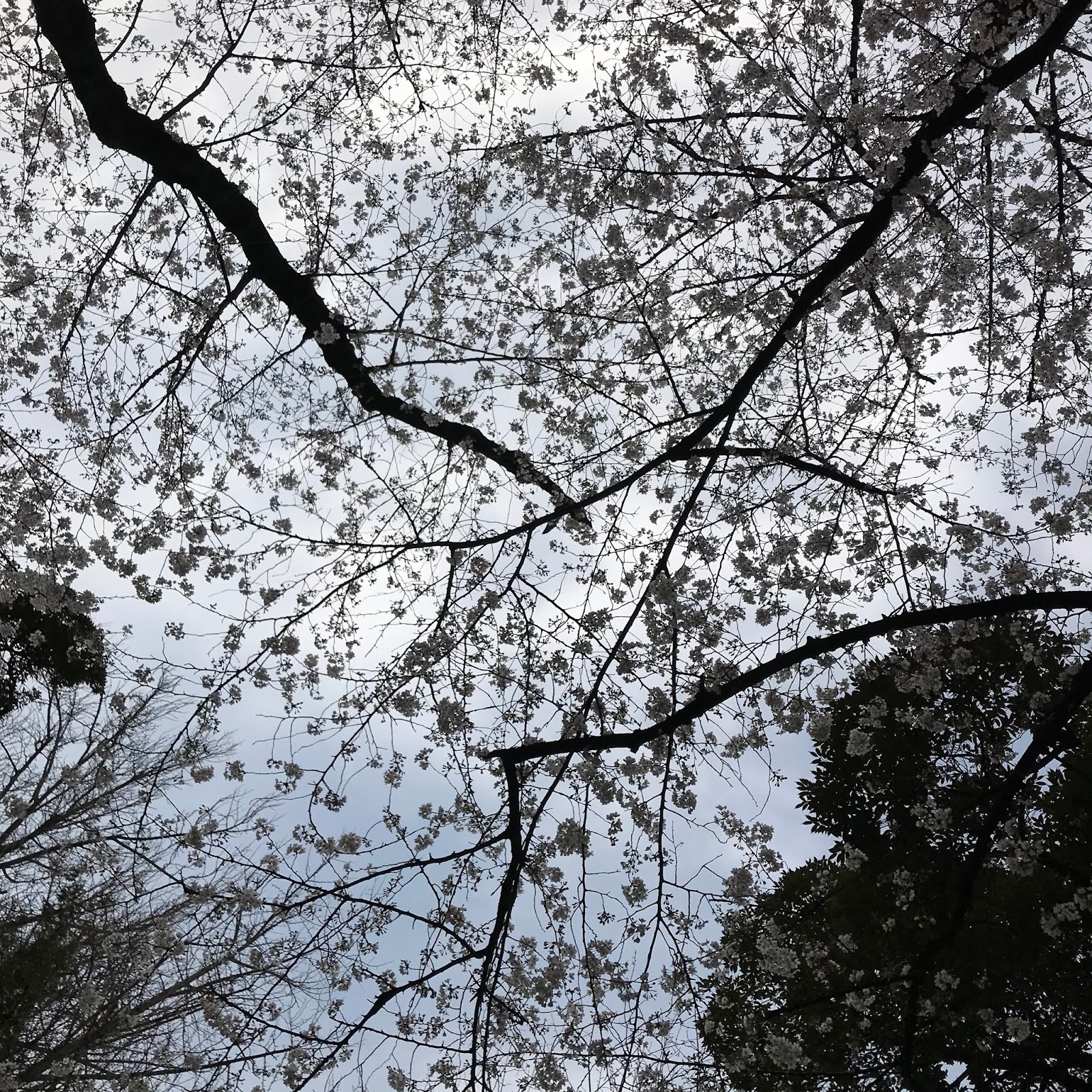
The color of the blue sky when viewed through sakura is amazing.


Daikoku Jinja is a Shinto shrine for personal worship of one form of Daikokuten. That is the god Okuninushi-no-Mikoto, a descendant of the god Susanoo. 

The Komagome Bridge is next to the shrine. It spans the rail road tracks below.

The bridge has a couple interesting details like the metal work flowers for fencing, with Mt Fuji above them.

Another view of Komagome Bashi.

Monday, April 27, 2020

Sakura at Hanazono Shinto Shrine in Shinjuku

I started March 23rd with a chocolate taiyaki from 7-Eleven.  

Afterwards I headed to Shinjuku-sanchome Station. Less crowded than Shinjuku Station and it put me very near my first destination. Marui Annex and KERA SHOP. I wanted to see the new Moi-même-Moitié Candelabra Embroidery Shirts, and everything else they might have. The shirts are very nice, but I waited on buying anything because I still did not know what my flight situation was going to be. It was still really nice to be able to see KERA SHOP's window display. Very classy!

Of course I was still wanting to see sakura. And I knew of one place it would be at, that would be easier to get to and hopefully not be crowded. Unlike Shinjuku Gyoen National Garden, which is prime sakura viewing for locals.

In 2018 I visited Hanazono Shinto Shrine. I remembered the sakura trees were just beginning to bloom. Since this time it was later in the month, I headed over to the shrine. 

I went through the main torii this time, guarded by this a-gyo open mouth komainu and child.  

With the un-gyo closed mouth komainu partner, paw on the ball of wisdom. Open mouth represents the letter A which is the beginning of all things, and closed mouth represents Um which is the end of all things. Together they represent the sacred sound "Aum".

As for the shrine, the sando leading to the haiden was beautiful. 

The sakura trees were in full bloom. 

Even with grey skies, it was lovely. 

Of course blue skies would have been wonderful, but then probably a lot more people would be there. Thankfully there weren't too many and most people kept some distance from each other. 

Since I had been here before, I didn't spend much time looking at the shrines. I was here for this view. 


It's really nice how the trees sometimes have little buds springing from their trunks. Being able to see sakura closely is special. 


Looking at this, I can't help but think of in anime, they often will have sakura trees. I do recommend visiting Hanazono Shinto Shrine in Shinjuku when the sakura bloom. 


Tuesday, April 21, 2020

Ikebukuro Mitake and Kosodate Inari Shrines

I am not sure where I took a photo of these flowers. Maybe at the beginning of my walk on March 22nd, at a store along the way? All I know is they were very pretty and smelled lovely. I made a practice of smelling flowers during my trip. I thought the photo would be a nice way to start this blog post.

I do know I had a coffee and chocolate bagel from Boulangerie Asanoya. I had wondered how they would make their business safer. They had put plastic sheeting in front of all the different baked goods and also were individually wrapping many of them. As for the taste of the bagel, it was just as I expected. Coffee with an under taste of chocolate. It was a nice breakfast.

I had originally planned to go to a number of places during this trip. Along with seeing the Lalique exhibit. But museums were closed and I was concerned about traveling too far away. I was still not sure about my flight back to America. JAL was cancelling flights every day so I didn't know if I would need to deal with booking a new flight with another airline, and how to pay for that if it was really expensive. Or then having to arrange for a longer stay. It felt unsettled. 

So I went for a walk in the neighborhood. I didn't have far to go to visit another shrine. Ikebukuro Mitake Shrine, 池袋御嶽神社. 

Something special about going for walks during this time of year, all the flowers that bloom. Little violets finding a way to live in the cracks of old stone steps. How old? Mitake Shrine is thought to have been built around 1687.

 After entering through the torii, to the right is a very nice chozuya. Seeing this made me realize something about Japan.

Really cute instructions on how to purify yourself using the chozubashi. It's read right to left by the way. 

Next to the ablution pavilion is this family of owls. Because of course, this is Ikebukuro. Also, the shrine is guardian of the west exit of Ikebukuro Station. So here are some of the west exit owls.

 Something to notice, behind this wooden sign next to the chozuya, is one of the komainu. I'm not sure why they have hidden it, but the sign board looks new so maybe it was placed there for an upcoming festival.

 Another sign board with a history of the shrine. 

 The other komainu is out in the open and rather nice.

 Along with one of the shrine stone toro.

 Various omamori are available, along with owls. 

 You can also get items to create your own home Shinto shrine. And little foxes with prayers written on them. As to what the prayers are about, I will get to that.

There is a nice open walkway, sando, to the haiden.

There is a kagura to the side, along with framework for holding paper lanterns, chochin, I think. Or it is for wooden signs. Perhaps for a festival.

Speaking of chochin, there were new paper lanterns in front of the main shrine. 

I'm not sure what kami is enshrined at Mitake Shrine. There are four gods mentioned but I am not sure of their correct names. Two are Yamato and one is listed as Emperor Jinmu, 神武天皇, first emperor of Japan. The god of food and god of thunder and sword are referenced on the shrine's website here http://mitakejinjya.sakura.ne.jp/. One focus of this shrine is for fire protection and disaster relief.

To the side, another family of owls. Why a family? 

This relates to the Shinto shrine next to the haiden. The kitsune were impressive. 

The Shinto shrine is Kosodate Inari Shrine, 子育稲荷神社.

 Rather toothsome kitsune.

 They guard the way through several crimson torii.

So why the owl families? Because this shrine is where people pray for safe childbirth, healthy children and to become pregnant. 

It is a shrine for parenting. Inari is a god one prays to an increase of crops and fertility. 

Here people leave little kitsune ema with prayers for protection. 

Next to this was the shrine mikoshi, portable shrine.

One last look at the chozuya. As to what I realized, in Japanese culture, washing hands is something that has been done for centuries. It's part of the religion. So it makes sense that in Japan, it's not difficult to get people to wash their hands, to think about trying to purify oneself as a way of making it safer, to prevent infection from the virus. Which may be one reason the rate of infection in Japan was slower.