Mana's Beautiful World is Forever

Mana's Beautiful World is Forever
Showing posts with label Shinto shrines. Show all posts

Tuesday, June 16, 2020

Back to Enshu Inari Daimyojin and More

Even though it was no longer snowing, there was enough left to make everything look different.


I passed by 延壽稲荷大明神, Inari Daimyojin while walking to my destination. I had hoped there would be more snow on the backs of the komainu.

A lot of the snow had melted but the shrine was still interesting to see again.


I also found another Shinto Inari shrine. This one is located between residential buildings, so I had to search a little to find it.


There isn't a name listed for it on Google maps, but it definitely is an older shrine.

So I do not know the kami that is enshrined here, most likely Inari as a protector of local businesses and the people who live here.

The green moss or lichen has created a strange effect with this kitsune's eyes.

There is a bit more realism of the bodies of these kitsune. I wonder if there was a kit, a baby fox with this one. 

Wednesday, April 22, 2020

Sanja Shrine

Not far from Ikebukuro Mitake Shrine is this lovely sakura tree.


I could spend all day looking up into those branches. 

And luckily there are pretty blossoms closer to the ground. 


Across the street is a little Shinto shrine. I do not have information as to the name. It is most likely an Inari shrine for neighborhood businesses. 

There is a small broken monument there also. 

I do know the name of this little shrine. It is Sanja Shrine and it's hidden in between residential buildings, down an alley. 

The chozubashi is very natural looking. 

The little area around the shrine is a tiny garden. From what I read Inari is enshrined here.

 On the outside is a wooden plaque that reads Hakushima Benzaiten, 嚴嶋辨財天. So this may also be a shrine for Benzaiten. That might explain the type of water basin there. In the past, as now, north west Ikebukuro had an entertainment district. It would make sense that Benzaiten would be enshrined in the area.

The garden is very pretty. With tiny sakura and ume trees, and camellia bushes. 

Lots of iris japonica were blooming. 

Violets 

And other flowers. It was a nice place to visit, very near Ikebukuro Mitake Shrine. I did stop back one more time during my trip. For a good reason. I will share those photos later.

Wednesday, May 15, 2019

Owl Road and Zoshigaya Shrines and Temples

 After my visit to the Reading Glasses Museum, I decided to take a look at some of the shrines and temples near Ikebukuro, Toshima. Toshima Ward is known for the shrines and temples in the Zoshigaya area. There is even a Seven Lucky Gods walk that you can do.

There was a feeling of older times along the roads in the area. It was nice and quiet also, with very few cars in this neighborhood. 

Along the way there are views of numerous temples and shrines. I will mention a few in a couple other posts. 

Although I was too early for the full sakura blooming, there were a couple trees showing off early. This area is also known for its wonderful sakura viewing.

Along with enticing views of Japanese architecture. 

 Part of my walk was along Owl Road. 

 One of the translations of Ikebukuro's kanji is similar to the word "fukurou" which means owl. Locals have made use of this with many images of owls throughout the area. Including this road through Zoshigaya.

One could imagine owls enjoying the trees along this lovely shaded road. 

With it's glimpses of of shrines and temples. 

 And many owl statues.

It was nice to see the various stone work along Zoshigaya's Owl Road.

Tuesday, July 10, 2018

Tsukuda Shrines

When I was searching for information about the Midori statue, I found some old maps of Tsukuda Island. The first is an Edo era map of 1771 of  Tsukudajima and Ishikawajima. This would have been before the ninsoku yoseba, criminal and poverty stricken rehabilitation facility, was established. Part of the islands belonged to the Ishikawa samurai family, which is why there are two names for the area. The other part was Tsukuda, which is where the shogun's fishermen lived and kept their boats.

As you can see from the maps, the land mass of the islands grew. This is an army survey map from 1892. Before and during the Meiji Restoration period the ship building industry increased here also. By this time the area was known only as Tsukudajima.

The last map is a detailed Meiji era map. The amount of reclaimed land is even more and the water way became narrower. Eventually the ship building moved elsewhere in 1979 and the area became mostly residential with shops and businesses. And became known to most as Tsukuda. Although it still retains many of the same roads and some of the older buildings.

While there are only a few boats around Tsukuda now, there are still reflections from when the island was known for fishermen and ships. One place is Tsukuda Namiyoke Shrine.

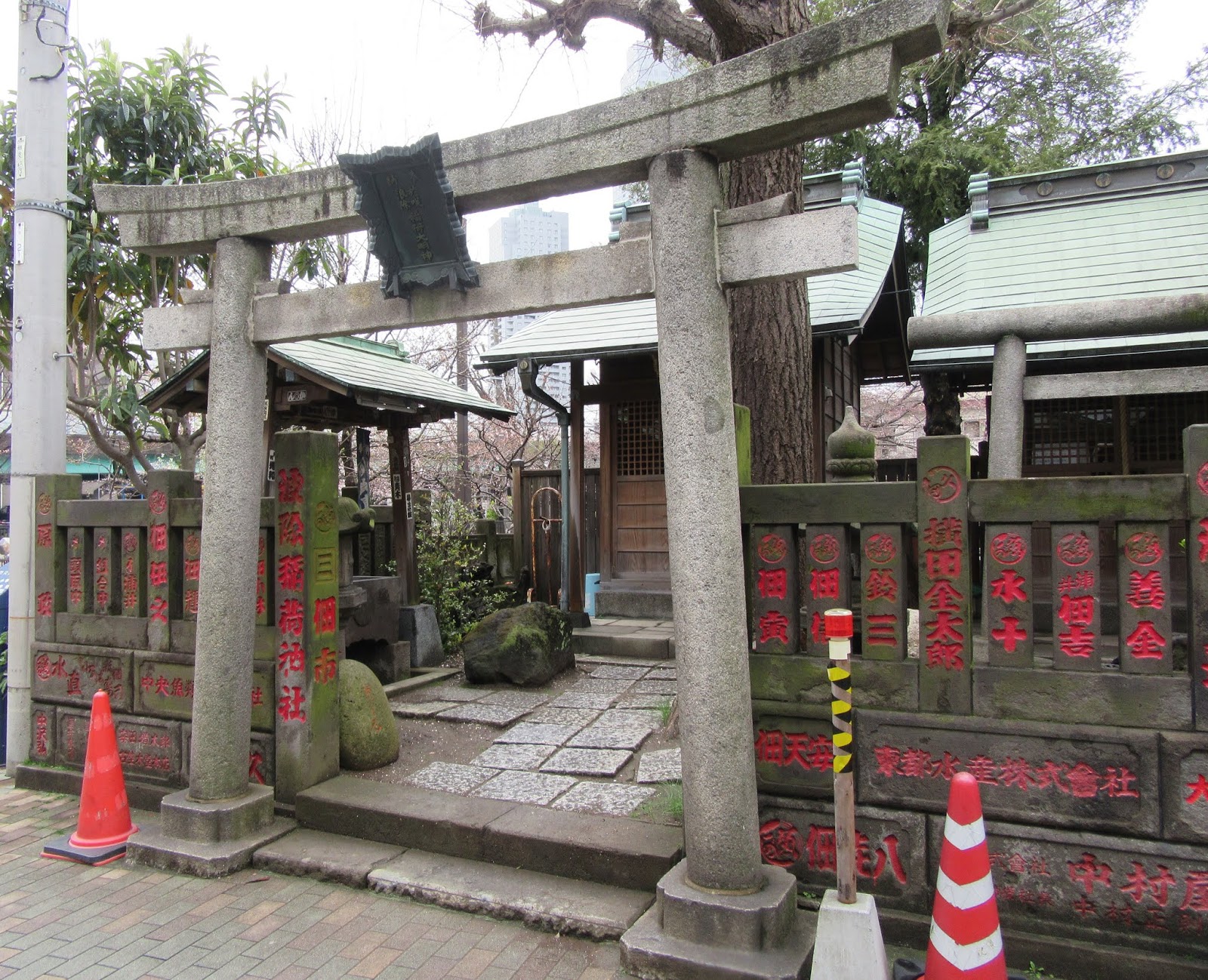
Tsukuda Namiyoke Inari Shrine was built as a place to pray for the safety of the fishermen. It is located near the Tsukuda Kobashi bridge, where the fishermen lived and kept their boats.

Even though it is small, it is well cared for. One feature of the shrine are the power lifting stones, like the one at the gate. These were used in contests of strength and are found at some shrines. The one here has "oshiri" written on it, which means smooth like one's bottom.

Another shrine in Tsukuda is Sumiyoshi Jinja. This was founded by the Osaka fishermen in 1646 for protection for their ships. The large torii features a ceramic name plate.

I don't know the age of the buildings here. Most shrines in Tokyo were rebuilt after the war. Many also are rebuilt at certain times since they are made of wood.

One of the guardian komainu at the shrine.

This is the Haiden, where prayers are offered to the enshrined gods. To the left is a brick building where the portable shrine, the mikoshi, was stored.

One of the smaller shrines. Sumiyoshi Jinja is one of the few places that has the names of the individual shrines on Google maps. This is the Funatama Shinto shrine. Interesting details on the shrine doors and carvings around the shrine.

This is the Eki Jinja Hoso shrine.

One of the amazing looking trees in the area. I do not know how old this tree is but the trunk is massive. Unless it was large when originally planted here, it probably has been here for a long time.

This post is similar to the one at the shrine in Hamamatsucho.

There is also an Inari shrine here.

Irifune Inari Shrine

The portable shrine, the mikoshi, is now stored in a newer building. Unfortunately since there were no lights on inside, this is the best photograph I could get.

A look at the grounds out towards the entrance torii.

And a bit of sky clearing near the end of my visit to Tsukuda. But not the end of my day walking around places in Tokyo. More from this day in my next post.