I started out this day by stopping in Excelsior Caffé for a tuna sandwich and coffee. Their food and coffee are fine, but they do have an odd music play list for this place. I noticed that in other places, where the choice was English language songs. Some of the lyrics...well, just odd.
Getting past that, I took a train out to Fukugawa. I should take more photos of places like this, they don't get enough love online. Fukugawa is in Tokyo, and a lot of Tokyo looks like this, suburban areas. Except for the nihongo, this street of stores could be in a few other countries, like America, and fit right in.
Because it was June and the weather was warm, I wanted to see green cool places and flowers blooming.
So my destination this day was another garden. Kiyosumi Garden.
Kiyosumi Teien (garden) was created as a tradtional Japanese strolling garden. One of the features of it are the traditional Japanese buildings that are seen as one walks around the pond.
There are a number of bridges too.
I've seen stone zig-zag bridges in other Japanese gardens. It is a popular feature.
There were a few flowers starting to bloom like this little hydrangea at the water's edge.
Out on the pond I saw my first bird, this Spot-billed duck.
The land for Kiyosumi belonged to a daimiyo, Kuzeyamato Mamoru, who turned it into a garden area back in the Edo period.
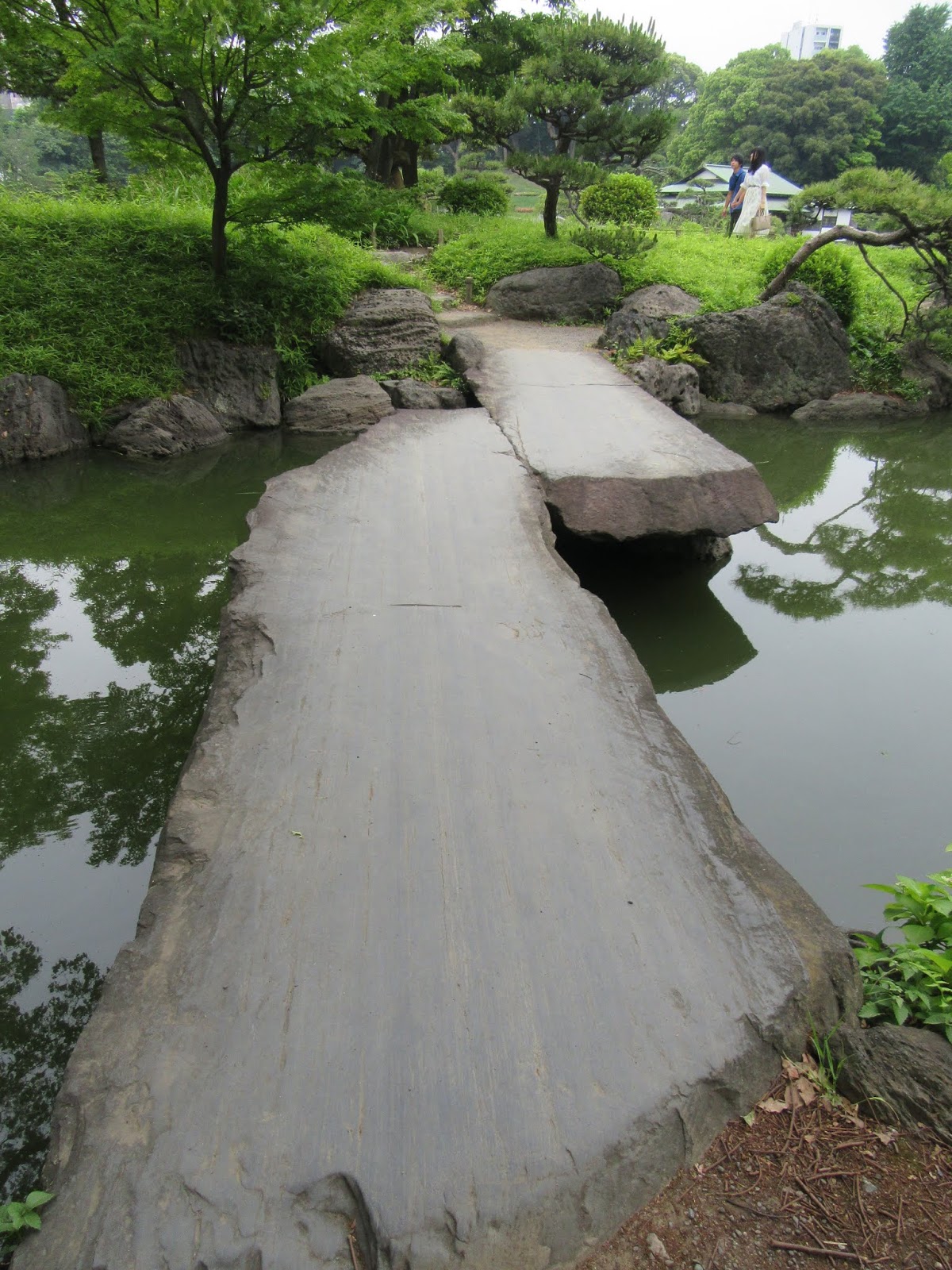
In 1887, the founder of Mitsubishi, Iwasaki Yataro, purchased the land and had work started to rebuild the garden for his employees and important visitors to use. Iwasaki was a stone collector so the rocks in the garden were brought here from all over Japan. Including the ones used for this
iso-watari stepping stone bridge.
I was spied while walking along the water's edge.
There were a lot of turtles and koi here. It was relaxing to sit and watch them.
There are three islands but only one is accessible by visitors. This makes the islands a nice place for birds, like these gray herons.
The fountain pond was enlarged by the Mitsubishi Group by adding waters from the Sumida-gawa.
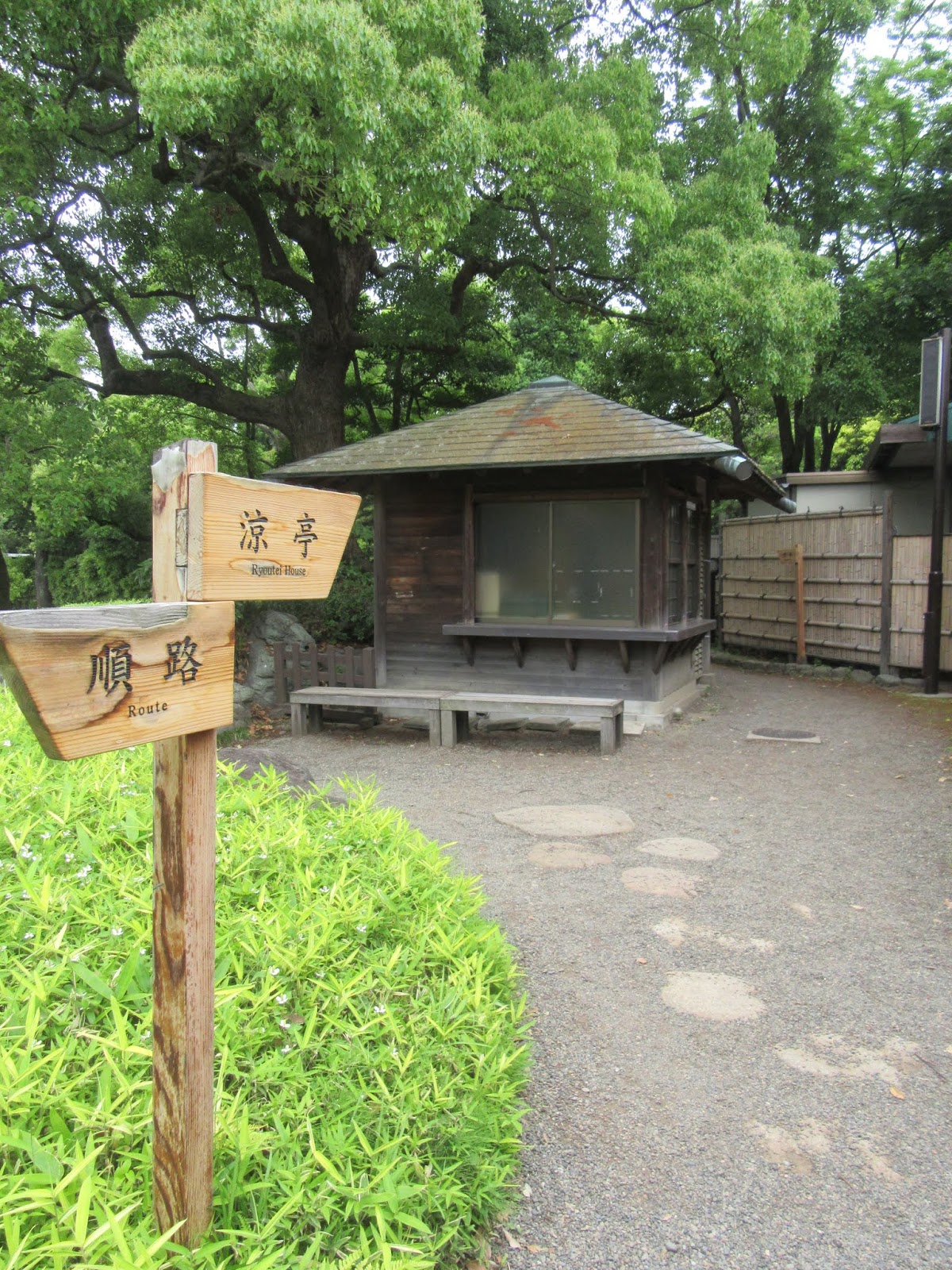
And from most places you can see the tea-house styled Ryotei restaurant. I understand reservations are needed to dine there or if a group wants to rent it for events.
There are a number of man-made hills in the garden. The one to the left past the bridge is named for Mount Fuji, being the tallest of the hills. Azaleas were planted there so that when their red flowers bloomed it would remind people of Mount Fuji.
A more rustic styled bridge along the path around the pond.
And gray herons and turtles enjoying the good life.
The hydrangea were beginning to bloom. They were lovely to see but I was also there to view another type of flower.
Meanwhile on my stroll I came across this shrine set in the side of one of the hills.
I have not translated the sign that is next to it since the text on it is lengthy. The hand positions of the Buddha in the middle are for "welcome" and granting wishes for those who follow Buddhism. It is possible the multi-armed god on the left is Marici, who was worshiped by samurai and would fit with the prior owners of the land. Also I've seen the three "speak, see, hear no evil" monkeys on the right in other places where Marici images are. They are in order Iwazaru, Mizaru, and Kikazaru.
Meanwhile, back out on the pond, the gray herons are still relaxing.
It's amazing to see so many in one place.
The tea house Ryotei and the Taisho Kinenkan. The Taisho Kinenkan is a memorial hall dedicated to Emperor Taisho. I didn't know at the time it was used as his funeral hall. It was destroyed in WWII, but since rebuilt. Sometimes it is open for visitors, and it was when I was there. I will have a little more about it in my next blog post.
Before that one last gray heron which flew over to where I was. I was very careful not to startle it.